

 The Distributed Object Environment
NonStop DOM Framework Configuration Management
NonStop DOM Framework Performance Tuning
NonStop DOM Framework Troubleshooting
What You Need to Know
The Distributed Object Environment
NonStop DOM Framework Configuration Management
NonStop DOM Framework Performance Tuning
NonStop DOM Framework Troubleshooting
What You Need to Know
This section provides an overview of the tasks involved with managing the NonStop DOM distributed object environment. As described in the installation topic, the NonStop DOM system implements the ORB on the Tandem NonStop Kernel. To manage the NonStop DOM distributed object environment, you must configure and modify the settings of the NonStop DOM system. Managing this environment includes monitoring the system processes contained in the NonStop DOM system, monitoring the underlying networking resources, tuning the system configuration for performance, and troubleshooting the ORB.
Figure 1 shows the major components of the NonStop DOM system runtime environment and the tools you use to manage each type of component.
Figure 1. NonStop DOM Runtime Components
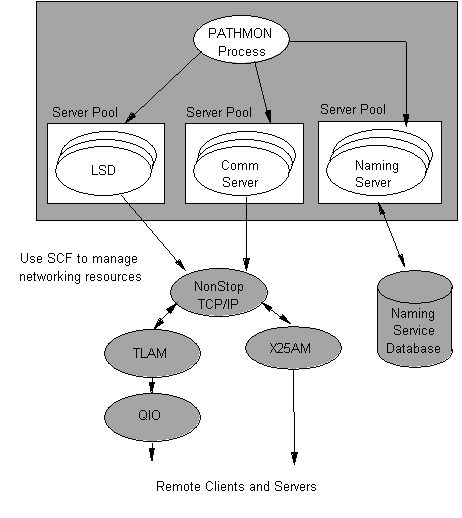
The NonStop DOM system is implemented as an application using NonStop Transaction Services/MP (NonStop TS/MP), which provides for scalability and load balancing by allowing multiple processes to work in parallel to perform the same task. NonStop TS/MP also provides for availability: its monitor process, called PATHMON, automatically restarts a process that fails. Because NonStop TS/MP provides all process management for the NonStop DOM system, you use NonStop TS/MP interfaces to configure and manage the NonStop DOM system processes.
The user interface of NonStop TS/MP is a line-oriented utility called PATHCOM. PATHCOM includes commands for setting and reviewing configuration options, starting and stopping processes, and gathering information about process status and utilization. You can use PATHCOM interactively or by means of command files. You can also write applications that use the Subsystem Programmatic Interface (SPI) to perform any function available through PATHCOM.
To define and maintain the configuration of networking resources (TCP/IP, TLAM, QIO, and X25AM), you use the Subsystem Control Facility (SCF) or write an application that uses the SPI. The SCF and corresponding programmatic interfaces include commands for setting and reviewing configuration options and for gathering information about the status and utilization of communication lines, processes, and related resources.
Performance tuning of the runtime environment of the NonStop DOM system is primarily a matter of deciding on the number and relationships among Location Service Daemon (LSD), Comm Server, and TCP/IP processes:
The use of underlying networking services (X25AM and TLAM) by TCP/IP can also affect the performance of the NonStop DOM runtime environment. You use SCF to establish and monitor those relationships.
Caution: NonStop DOM does not use NonStop TS/MP to provide automatic load balancing for Comm Servers. Instead, the relationships among clients and the Comm Servers are fixed by the LSD configuration. Thus, assumptions about NonStop TS/MP load balancing and performance tuning will not always apply to managing the NonStop DOM runtime environment.
For example, a bottleneck could occur in a Comm Server even if other servers in the pool were idle; in this case, you would improve performance by using using the Configuration Tool to modify the assignment of clients to Comm Servers rather than by using PATHCOM to add Comm Server processes.
Often a perceived problem with the NonStop DOM system performance is actually the result of application design and configuration, such as the use of requests to stateful objects and the locations and design of objects that frequently exchange data.
The most common problems preventing successful operation of the NonStop DOM system are the following:
A problem that arises in the interaction between the NonStop DOM system and some other ORB typically requires collaboration the remote administrator. For this purpose, your best tool is a full, up-to-date set of the NonStop DOM and SCF configuration files. However, several automated tools can also help you troubleshoot your local NonStop DOM system:
To manage the NonStop DOM runtime environment, you should be familiar with the following topics:
The Bibliography contains references to the Tandem manuals that contain information on these different systems.